Showing posts with label media. Show all posts

Saturday, September 4, 2010

Compartida, la vida es más

This title is a tag line from a TV mobile network company ad broadcasted in Spain during this spring (Spanish readers, correct me if I'm wrong ;)). It means "Shared, life is more". As a linguist, I am still pondering over the sense of grammatical unfinishedness of the tag line, but bear with me, "professional defect", I put a great dose to control myself but am not always successful...But that's another matter.

There were different ads (you can see them in Youtube) with the motto, but if I had to choose I would take this one:


Until the end of the ad, you are not sure what it is about...then you see the motto and start noticing some details...which ones do you get? Do you think the motto is appropriate? And, last but not least, do you like the ad?

The more I watch it, the more I am amazed on how well it was orchestrated!

Sunday, July 25, 2010

Mystery of the abandoned bicycle

This is just a little peculiar story that took place last Friday in Turku, Finland, and that was covered by several national newspapers and tabloids. Here's a loose translation of the version in Turun Sanomat.

The abandoned bike. Image published in Turun Sanomat.

Sunday, July 11, 2010

Cycling between the fronts

Do you know people who cycle daily because cycling is their job? Who comes to your mind? I naturally always think about bike messengers, mailmen, rickshaw whallas and bicycle taxi drivers, newspaper deliverers, ice-cream sellers and that kind. Recently I also came across cycling policemen in Vienna.

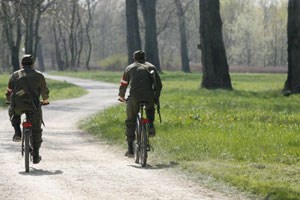
But what about people in very rural areas? There are generally little paved streets and it's tough going. Countrymen use tractors and robust four-wheel drive. Sometimes, however, such vehicles are too big. The military, for example, uses bicycles to patrol at the Austrian border in Burgenland:

Wednesday, July 7, 2010

Discover your town!

Whenever I think about city-cycling I think about the German campaign Radlust which deals with the promotion of federal cycling traffic. The term "Radlust" could be translated to "the joy of cycling". The aim of the campaign was to -- literally speaking -- mobilize the unused potential of the bicycle in cities (nearly all households in Europe own at least one bicycle) by remembering their owners about the pleasure of movement:
>> If you want to build a ship, don't drum up the men to gather wood, divide the work and give orders. Instead, teach them to yearn for the vast and endless sea. << (Antoine de Saint-Exupéry)

Whenever I cycle on the weekend myself, try new bike routes or generally explore areas that I have never been to before by bicycle, I too feel this enthusiasm and pure joy of cycling. Last weekend was one of these occasions...

I put on my new stripy jersey dress, carried Paula up from the basement and set off for the unexpected. Also with me, a map printed from anachb.at (useful Viennese-area route planner), sunglasses, a hat and some of my cameras.

panda with new dress

Sunday, June 27, 2010

Radfahren in Wien -- a review of Vienna's new bicycle guide

"Radfahren in Wien" (Cycling in Vienna) is an extensive handbook with a lot of useful information about cycling. Although it is strongly related to Vienna, I can highly recommend it for a general German-speaking audience (in particular, if situated in Austria). This is, because it is an exhausting and wittily written, smart and neatly designed handbook on almost anything you ever wanted to know about cycling.

"Radfahren in Wien" by Alec Hager and Johannes Pepelnik

Monday, May 24, 2010

A short story about the back pedaling brake

Yesterday I saw a nice video clip about the pros and cons of a back pedaling brake (also known as coaster brake) in one of my favorite programs called Karambolage on my favorite tv channel Arte. Arte stands for Association Relative à la Télévision Européenne and is a quality European culture channel. They broadcast in German and French. Many of their own programs can also be viewed online on arte.tv. Unfortunately I could not find Karambolage. But the text of the clip (here in German and French, by Corinne Delvaux) and the pictures are available on their website. It roughly translates to the following:

Wir sind in Berlin. Das sieht man doch am Fernsehturm im Hintergrund, oder? Gut, dieser Herr ist Franzose und er freut sich, denn seine Berliner Freunde haben ihm ein Fahrrad geliehen, um die Stadt zu besichtigen. Super.

We are in Berlin. That's obvious because of the tv tower in the background, isn't it? Well, this gentleman is a Frenchman and he is happy that his Berlin friends lent him a bicycle for sightseeing. Great.


Sunday, May 16, 2010

FEEL FREE! -- Advertising cycling and why I still don't like E-bikes

Lately I have seen some billboards with bicycle ads. In fact, the don't advertise bicycles in the sense of bicycle brands, but cycling as such. There is, for example, the Citybike Wien ad which obviously aims at young people:

This picture is from an article by the Greens in Simmering.

In contrast, there is the Wien Energie ad about E-bikes:


Tuesday, February 9, 2010

Velosophing

As some of you already now, I am co-blogging on the Austrian bike culture community velosophie.at. This website has developed from the homonymous free bike magazine velosophie, that is enclosed in the Standard newspaper a few times a year. The back issues are also available online.

The velosophie blog on the very same homepage exists since May 2009 and so far different people wrote about bike related topics: Alec, Thomas, Bea, Inga, Eva, Karo, Günne and me. As you can propably guess, so many people create a fair mixture of opinions and topics . On Sunday a few of us met for dinner and the exchange of ideas. Was a lot of fun, and hopefully also fruitful.

We're there to entertain YOU (at least the German speaking part). So keep an eye on velosophie.at, watch our progress, and -- most importantly -- let us know what you think!
Velosophie Blog Team: Thomas, Bea, me and Alec

Tuesday, February 2, 2010

Media image of cycling

Last Saturday anna wrote about the image of cycling in Austrian media. Today I'm writing about the same subject in Finland.

I reviewed about 30 articles that were published on January 2010 on 5 newspapers' websites. Cycling was by far the best represented in the newspaper Helsingin Sanomat, which had a half of the articles.

Many of the stories were about accidents and sports. I couldn't be bothered with the sports stories, but there were a few stories of cyclists being hit by cars. Anna mentioned that there are more and more cyclists being killed and injured in the traffic accidents these days in Austria. Well, I don't know about the how it is in Finland altogether, but Turku the numbers have gone down as the cycling infrastructure has improved. I don't think that the cyclists are blamed for the accidents even implicitly.

The rest of the articles were about varying subjects. There were a couple of articles about bike thefts. One theft story was a funny thing from Denmark: a thief had stolen a bike, but he didn't notice that there were 3 kids on the back of the 3-wheeled bike, and so he stole the kids too :) Fortunately he was a good-hearted thief and took the kids back home following the eldest one's instructions.

There were also a couple of articles related to the health benefits of utility cycling, and an article that appealed to the motorists to consider cyclists while driving. All 3 of the cycling accidents on the news were caused by irresponsible motorists, so this plead was not made for no reason.

One article was about cycling infrastructure in Joensuu, eastern Finland. The writer was pleased with the city infrastructure, but hoped that bike lanes were better maintained in the wintertime and that people wouldn't cycle on the sidewalks. Riding on the sidewalks is a common problem in Finland. You are not supposed to do that, but sometimes you've got no choice. For example, there is a busy road (uncrossable without traffic lights) on the way to the supermarket where I do my shopping. For about a 50 meters, the bike lane just disappears on that side of the road (see the pic). It seems unreasonable to take the long way round and wait and cross roads to get back to the place where the lane starts again. Besides, all the bike racks and university buildings are positioned on that side of the road that has no bike lane. A bit stupid, eh? Solutions like that are driving us on the sidewalks. Also, in the winter it is very dangerous to ride on carved icy car tracks among cars. If you are not willing to risk your neck, you sometimes have to choose the illegal sidewalk.

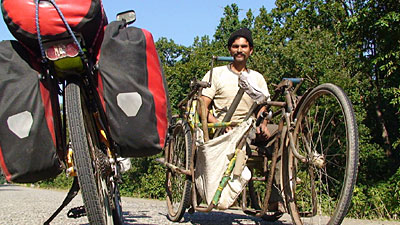
There were also a couple of really nice pieces of news. One of them was an article about a man, who is cycling all the way from Finland to Greece. Other one was a webportage about pimping bikes. It seems to be in fashion nowadays. I've seen some fancy paintwork like zebra bike and a flower bikes in the neighborhood.

However, the piece of news which made me really happy, was the one about proposed changes in the traffic law :D A working group is pondering on the issue of cycling on sidewalks and they also hope to make cycling otherwise as convenient as possible. You see, promoting cycling is a part of many local and sectoral Agenda21 plans (e.g. Turku plan) in Finland, and it is also an essential part of the national sustainable development strategy. Here's some of the things that the working group had thought of:

  • the right to ride a bike the wrong way on one-way streets

  • giving up the compulsory use of bike lanes (I didn't know that it was compulsory :)

  • allowing cycling on sidewalks

  • introducing bike pocket, which is a space in traffic lights in front of the cars that is reserved for bikes . This would mainly benefit those, who like to ride really fast among the cars (not me with my single-geared!)

Nice plans, eh? :D

To compare the image of cycling in Finnish media with the Austrian one, it seems that the image in Finland is much more positive than the image in Austria. It is recognized that cycling among cars can sometimes be dangerous and that it is not the cyclist's fault. There were also some positive articles on cycling infrastructure and legislation. The nation and municipalities are clearly trying to improve the situation of cyclists in the traffic. Also, the press, especially Helsingin Sanomat, brings forward the health benefits of cycling, and also the fun part of it. I'd like to think that the press reports about cycling in a positive way in part because Finnish media is supporting the national sustainability strategy.

Saturday, January 30, 2010

Let's have a big round of applaus for media's attentiveness

Did you ever wonder about how much power media has on our lives/mobility? I will examine this power now for print media in Austria, but it also applies to TV stations, radio etc. Please note that I will just try to give some good and bad examples of newspaper articles related to cycling and maybe one should not extrapolate from that to general statements, although it might be tempting.

Negative publicity:

Last year, around the same time, there was an article in the Kurier (an Austrian-wide newspaper) that upset many people who use their bikes on a regular basis. They claimed that cyclists in the winter are simply irresponsible and stupid. I translated and summarized the content of the article earlier, see "Is cycling in the winter dangerous?" if you're interested in the details.

An even worse article is "Radlerdemo endet in Randale" ("Bike demonstration ends in riots") in the Österreich newspaper in 2007. It accussed the participants of the Halloween critical mass of damaging cars despite lack of any police evidence. I personally was there, and did not observe any misbehavior.

I also consider an article about traffic controls in Vienna in the Krone newspaper as rather negative. It mentions the fact that more and more cyclists and pedestrians get injured and killed these days and that the authorities try to countersteer this. However, their main message was that cyclists often do not obey the traffic rules and implicitly it's their own fault when they are run over by car drivers.

Click on the pictures for enlargement

Useless advertising:

Ever seen a bicycle promoted in a newspaper ad? No? Well, sometimes there are ads by sport outfitters (only chains though) that want to sell cheap and crappy mountain bikes. This phenomena is closely related to the spring sell of shitty bikes by food chains, and only addressed to people who -- once a year -- have a wasteful desire to work on their body (I wrote about it last March). These bikes are mostly used once and then rot in a corner. That's why I consider these type of ads rather useless or even counterproductive for a bicycle culture as such.

The above is, on the other hand, accompanied by all these commercials that want to sell us cars. They are everywhere -- in newspapers, on the radio, the TV, on billboards, on flyers, in lotteries, in subway stations and trams. Lately I even came across a car advertised in a showcase at the Danube canal bike path. It's hard to ignore them. Very often they also sneak into usual newspaper articles. I'm sure you are aware of certain "car sections", but have you ever seen a "bicycle section" or a "train section"? I believe there is also some money involved. Or our society has been completely brainwashed already.

Positive publicity:

Yes, there are positive examples. The fact that the Standard became my favorite newspaper probably was not out of the blue. Alright, as every other newspaper they also promote cars and have a car section every Saturday. But they also print bike-related positive articles, and recently even established regular columns on bicycles, cyclists and cycling. For German speaking people I highly recommend the so-called Radkasten by Thomas Rottenberg and various bike stories by Guido Gluschitsch in the Automobil section. By now their articles get more comments than all these car-related ads which, in my humble opinion, clearly shows the need for more positive bike stories in Austria's media landscape. The started to fill a gap that was unknown to be a gap to most people.

Besides, it's not only their stories that attract me. It's the general design of their newspaper. They often just sneak in pictures of cyclists in everyday life. Let it be bike racks when they talk about the cold and snowy weather, a chic cyclist on the ring bike path (opposite of the parliament) when they remark that there is still no photovoltaic plant on the parliament's roof, a cyclist walking his bike along a road that has been closed down due to a water mains burst or a heavily loaded Chinese bicycle when they investigate Asia's economy.

No photo cells on the parliament's roof
China's economy booms
Water pipe burst on Währinger Straße

Of course, the Standard is not the only example of positive bike publicity. I should certainly mention, e.g., the Falter and Presse as newspapers that have an objective or positive view on cycling in general. I particularly like an article by Sibylle Hamann (editor for Profil) in the Presse about cycling, traffic and the interaction of people. Very clear and neutral. Read her article here: "Radfahrkunde für Anfänger".

Well, I simply love positive medial coverage of cycling! Or neutral articles in the first place. I started my own collection of some interesting (so far only German) newspaper articles in a flickr album.

Of course I'm eager to find more articles and am grateful for comments in case you spot some interesting ones :). Someone might even want to examine the media landspace with regard to mobility (as it has already been done for articles on foreigners and other minorities). Could be a very interesting topic for some socio-scientific research.

Saturday, January 16, 2010

Pedaling around Europe (in Japanese)

In the recent winter issue of the "europe" magazine, there was a short summary about bicycle culture and lifestyle in Europe, along with some links to interesting blogs dealing with the subject. Among others, we were mentioned too!

Cycling in Japan's "europe" magazine

The "europe" magazine is the official publication of the Delegation of the European Union to Japan and is published by its Press, Public and Cultural Affairs Section. The principal purpose of "europe" is to give information on all aspects of the European Union, in Japanese, to those interested in the European Union and EU-Japan relations. The magazine is published quarterly and is circulated widely among political, academic, media and business circles. If you're interested, you can read more on their website: Delegation of the European Union to Japan (home, in English) and EUROPE magazine.

Well, all the text is obviously in Japanese. The description of our blog should say something like:

The blog "Cycling is Good for You" is focused on expressing different views on cycling in everyday life across Europe. Young contributers from nordic Finland, continental Austria and sunny Spain post stories according to their cultural background and give diverse insights into biking related issues. Some of them have a professional background in traffic planning and provide technical insight while others relay careful observations from their streets. Thus a variety of personal stories and scientific issues are covered in an easily accessible manner. This provides a somewhat comprehensive insight in cycling culture and lifestyle in Europe. In keeping with the theme of the blog they make a point why and indeed how a bicycle is an ideal mode of transport, despite of or especially in today's bustling world.
We hope you agree :). Besides, "Cycling is Good for You" is more than one year old now. Thanks to my co-bloggers and to all of you for contributing and sharing your opinions. It's good to know different aspects to understand how bicycle culture is seen worldwide.

We also want to know what you like, don't like and if you have any special interests or wishes for the future. We don't make any promises, but we will certainly try to make you happy :).

Thursday, January 7, 2010

In for some tropical weather?

Actually I wanted to write about the snow biking conditions in Vienna these days, but my camera just gave up now. You'll have to wait at least till tomorrow for some pictures, sorry :(.

On the other hand, I picked up my visa for India today. Seems like some contrast at first. But it reminded my of a bike story I had read a while back in an Austrian newspaper:

Uwe Walter and Christian Sattelkow planned to spend 10 months on their bikes, starting from Graz in Austria and with destination India. The cycled in boiling heat and rain, conquered deserts and mountains, dealt with breakdowns, communication difficulties, diseases and accidents. Along the way they explored countries they didn't know yet. Altogether they wanted to cycle about 15.000 km. And all they took with them were two bikes and 30 kg of luggage each. They set of in Graz on the 17th of May 2009.

Some of their impressions in Turkey:


Unfortunately, Christian got sick in Turkey and Uwe did not want to ride through Iran all by himself. Still, Uwe decided to fly to Delhi instead and explored some places in Nepal and India by bike. Sounds like some adventure, doesn't it? If you're interested to read more about their journey, then visit their blog on derStandard.at (sorry, only in German): "Mit dem Rad nach Indien".

Another cyclist on the Mahendranagar HighwayStreet in Bihar

Still, I won't go to India by bike. Nor anywhere else in the near future. My bike is mostly my local transport, but not my roving vehicle :). Got any (bicycle) traveling plans yourself?

Wednesday, December 16, 2009

Lingerie on bikes

Earlier we already discussed whether there is something called "bike fashion". Well, there is, in some ways. But these days also the "usual fashion" is proudly presented on bikes -- even underwear! Here's a picture of the lingerie collection "Sonia Rykiel pour H&M" presented on beautiful old-style bikes in Paris:

Sunday, December 13, 2009

COP15 and cycling

COP15, the Copenhagen climate change conference, is trying to find appropriate mitigation and adaptation goals and strategies against climate change. Cycling is a carbon-efficient means of transport that in many cases presents a true alternative to driving a car. Let's take a look at how cycling has been showing in the first week of Copenhagen climate negotiations.

Denmark is a country of utility cycling, which can be an inspiration to both the conference participants and internationally. In Copenhagen, 1/3 of commuters cycle to work or school, but the city goal is even higher. Copenhagen is aiming at becoming the cycling capital of the world and hopes to achieve the cycling commuter rate of 1/2 by 2015. That city knows how to set a positive example!

Monday, December 7, 2009

There's nothing wrong with buying a bike in the middle of the winter

Maybe you remember my test ride on the Retrovelo Paul in November. It had a little poll in the end asking what kind of color you would choose for a Retrovelo Paula. Surprisingly enough the traffic white bike I was testing did not get any votes. On the other hand -- and that's now also the time to reveal my choice -- the pigeon blue came in first with a vast majority of 26%. I had actually already decided what kind of colors I would pick before I asked the question. However, it was really interesting to see that many people (Filigree, Carinthia, Justine, Trisha etc.) voted for the same bike and also mentioned the creamy tires and brown saddle and grips.

Well, here I proudly present my new beauty:

Pigeon-blue Retrovelo Paula (for the specs click on the picture)

I ordered the 7-speed version last week and am looking forward to receive my new bike some time in January :). In the meantime I just have to find a place to park it.

Many of my friends I told about my new steed already placed a reservation for a test ride which, of course, I will gladly offer. For the rest of you I can at least recommend Retrovelo's homepage and their catalogues (both in German and English)...

By the way, regarding benefits of cycling in the winter, I read in the news today that physical activity prevents depressions: "Bewegung beugt Depressionen vor". Psychiatrists claim that the lack of exercise leads to anergia and isolation, especially among young people. It's not only about prevention though, they also recommend physical activity, a regular day-night-rhythm etc. as part of a therapy in many such cases. The WHO tells us the following about physical (in)activity:

"Physical activity is defined as any bodily movement produced by skeletal muscles that requires energy expenditure. Physical inactivity, (a lack of physical activity) is an independent risk factor for chronic diseases, and overall is estimated to cause 1.9 million deaths globally.

Regular physical activity – such as walking, cycling, or dancing – has significant benefits for health. For instance, it can reduce the risk of cardiovascular disease, diabetes and osteoporosis, help control weight, and promote psychological well-being. Everyone should engage in at least 30 minutes of moderate physical activity every day. More activity may be required for weight control."

From my personal experience I can also tell that that cycling makes me a happier, more efficient and well-balanced human being (see "Is cycling addictive?"). I also see that many people don't care enough about their physical health which also effects their mental health in a negative way.

I'm curious if you have similar experiences to mine, especially if you only started everyday cycling recently. Did you notice a difference in your overall way of life?

Saturday, November 28, 2009

Campaigns against drink-driving

In Austria a lot of alcohol-related accidents happen especially at this time of the year. We have a Christmas market- and hence also a Glühwein and Punsch-drinking tradition (in English this is called mulled wine and glogg as far as I know). So recently we also have a new campaign against drink-driving (in German):

"Alkohol am Steuer: Könnten Sie damit leben?" / "Drink-driving: Could you live with it?"


It's all about first times (walking, car ownership, being promoted etc.) of Stefan and Tobias -- and about the first time drink-driving and it's consequences... I think the question "Could you live with the consequences?" at the end is of course dramatic, but still very realistic. There is a similar spot from Ireland (in English):

"Could you live with the shame?"


In 2002 we had this, well, rather funny spot about drink-driving in Austria which is more directed towards young people who, on the countryside, often heavily depend on cars when they want to go out. It shows three zombies coming out of their graves and talk about their last disco visit: how drunk they were, that one said he could still drive, that the others joined and wanted to drive to another bar etc. It ends with "Und was ist dann eigentlich passiert?" / "And what happened then?" before you can hear cars crashing in the background:

"Drink + Drive = Death"


Do you have campaigns against drink-driving in your country? Do you think such TV spots can make a difference? If so, which ones do you consider most effective? Do you think they have to be shocking in order to show any effect?

By the way, what blood alcohol limits do you have in your country? In Austria we have a 0.5‰ drink-drive-limit for car drivers (and basically 0 for beginners). However, this regulation is only written down in the Kfz-Gesetz (law for motorists). Generally, and hence also for cyclists, we have 0.8‰ limit which previously used to be the overall limit (before they lowered it in 1998). If you know German and are interested in details you can continue reading in the "Handbuch Alkohol - Österreich" and the newspaper article "Angetrankelt mit dem Fahrrad unterwegs" (about drink-biking).

Do you ever drink-bike? I really try to avoid that. When I plan to go out I either leave my bike at home or just don't drink at all. I think that a slow reaction can be pretty dangerous if one has to ride between cars. Thus in that sense it also matters where I'm cycling. I don't mind having a beer and cycling back home on a lonesome cycle path in the countryside. Good lighting at night, however, is always essential!

Tuesday, September 1, 2009

Tom Turbo -- the bicycle with the 111 tricks

Most kids in Austria know Tom Turbo very well. Tom Turbo is a kind of a bicycle, but not an ordinary one. He's a bicycle with a face, that can think, talk and drive around on it's own. But that's not the only thing he does. He observes, analyzes and solves crimes. He's a bicycle detective.

Tom Turbo is an invention by Thomas Brezina, one of Austrians most famous authors for children's books. There are dozens of adventures of the Knickerbocker gang that I have read when I was a kid. And most of these stories are actually known worldwide as his books have been translated into dozens of languages and even been picturized.

The wonder bicycle Tom Turbo is more interesting for younger kids. I remember that the books contain a lot of colorful pictures and gadgets. But it's not just the books. Since 1993 we even have a TV series starring Tom (Turbo) and Tom (Thomas Brezina) where they investigate different cases.

I think Tom Turbo is such a cool invention. It is obvious that a bicycle is the most suitable mode of transport for children as it brings them wherever they want to – independently of adults, and fast too. Or could you imagine kids to go through adventures while they have to be driven around by their parents?

Although I grew up with KITT in Knight Rider, I do prefer Tom Turbo ;-). Watch him in action if you like:

Tuesday, August 25, 2009

Bicyclist robbed bank

You won't believe it, but we had such a headline last week: "Radfahrer überfiel Bank".

So, what does this tell me? At first, it's strange. Why do they mention that it was a "cyclist". It's certainly not common to write headlines like "Pedestrian robbed bank", "Motorist robbed bank" or "Public transport user robbed bank". So, I find it kind of funny that they explicitly mention that in the headline, as if people riding bikes were generally criminals and could be identified by their use of a bicycle.

Secondly, it is of course absolutely eligible to use a bicycle as a get-away vehicle, and it's not the first time that people did actually get away because they were on a bike and the police was not. For that (and only that) reason I'm even tempted to sympathize with the bank robber as he was apparently pretty smart by choosing a bicycle. Well, it's time for the Austrian police to get on bikes too! Once I heard that some of them do, but I've never seen them in real life.

Cycle police in Japan, by Jonathan Fong

Tuesday, August 18, 2009

An incomplete field study in East Tyrol

I have some relatives in East Tyrol (Osttirol, in German) that I visited for a few days. East Tyrol in the very south of Austria, bordering Italy. To the capital Lienz one can get in a reasonable time from Vienna, but in the rest of East Tyrol it's basically impossible to move around without a car. Well, there is a regional train operating between Lienz and San Candido (in Italy, called Innichen in German), but it's very slow and only connects a few towns. Due to bicycle tourism it runs more often in the summer and it's also fairly easy to bring along bikes. On the other hand, there are no more buses (except school buses), not even taxis, in most of the rural areas although the population is constantly growing.

Due to wide spread settlement it is difficult to operate a good public transport system

My grandma is lucky because she can still walk to the town center on her own and has my cousin looking after her, but for most of the old and young people in East Tyrol living there means heavily depending on people that are entitled and capable to drive a car. Must be very depressing to feel so locked in. My grandma only realized that when my granddad died, who used to drive her around.

Most families own more than one car. The scenery is nice, but they pay a high price for living in houses far away from centers. Strange enough there are also many who choose to live so car-dependent: many build their houses further and further away from basic infrastructure (such that they can't even get a liter of milk without getting in the car) and accept long commutes to work. Bicycles are rarely used on a day-to-day basis.

Cyclist waiting to cross the main road through East Tyrol. Did he go shopping at the petrol station?

However, in the summer one can see many tourists cycling in East Tyrol. Most of them cycle downstream along the Drava cycle path and look like that they only touch a bicycle for one or two weeks in the summer. I'm not really into that type of cycling and I also don't want to promote it (as this is done extensively already), but as part of a field study this is certainly worth mentioning.

Yesterday I read in a newspaper that the city of Lienz supports the purchase of E-bikes by paying 10% (max. 150 €, altogether spends 10.000 €). This is of course a nice gesture and brings bicycles as daily means of transport back into peoples' minds, but similarly to the scraping bonus in Vienna it won't be enough. What cyclists really need is a reasonable infrastructure (e.g. safe bicycle parking in front of shops, restaurants, schools etc.) and bicycle friendly traffic planning and politics. I wasn't particularly looking for it, but I couldn't see any bike path or bike lane in Lienz. And I also couldn't see many cyclists, except road cyclists and tourists. They still have a long way to go, but I wish them good luck in increasing the number of everyday cyclists.

Saturday, August 15, 2009

Would you give away your old bike for 70 €?

Since Monday we have something called a Verschrottungsprämie (scraping bonus) for bicycles in Vienna. If one gives away his/her old bicycle and buys a new one (at least worth 140 €) 70 € are refunded. So far the campaign is limited to 500 bikes and only available for persons registered in Vienna. More information at the Standard and the ARBÖ. Altogether that costs 35.000 €. Already after one day people had to be put on the waiting list, but the campaign might be extended.

The term scraping, however, is misleading as the bikes are not actually thrown away but repaired and given away for free to poor people, or sold again. The bonus is a late response to the scraping bonus for cars at the beginning of this year. Back then 30.000 car owners in Austria got 1.500 € refunded for scraping their old car if they bought new ones. That cost 45 Mio €. Maff complained about it earlier in January.

What do you think about it? Would you give away your old bike for 70 € (= 100 $)?

I certainly wouldn't. Maybe my bike isn't worth much more, but although I'll buy a new bike soon I wouldn't get such a cheap but good secondary bike. And after so many years (14, to be precise) I'm also physically and mentally bound to my mountain bike :-).

Still, I can see that this campaign can be a great chance for some people that left their bikes abandoned in the cellar for a couple of years and now want to restart cycling. I think it's a good motivation for them and a good signal to everybody in this city that cyclists are appreciated and welcome. I hope of course that the campaign will be extended, 500 new bikes just can't do the trick.