Showing posts with label trip. Show all posts

Tuesday, April 13, 2010

Elephants, camels and hand bikes

One of the last places I've seen in India was Jaipur. It was a real treat after the stressful time in Delhi. Although there was a huge crowd of taxi drivers waiting and hassling me at the train station, the city itself was very relaxing.


Saturday, April 3, 2010

Rickshaws in Delhi

To be honest, I did not like Delhi. It's a stressful, noisy, overpopulated and dirty city. The whole place is covered in a thick pall of smog. The streets are filled with mostly men, and a lot of them are shamelessly staring at women. Not a pleasant place to be.

Maybe my bad experience is also connected to our arrival. One of the first things that happened -- even before we reached the hotel -- was a taxi breakdown in the middle of a busy street. It was hot, dirty and uncomfy. And it seemed to take forever to get out of this straining situation.


Saturday, March 20, 2010

Traffic in India

Beep! Beep! Apart from left-hand traffic this is the first thing one notices after coming to India. It’s the cars, autorickshaws and motorbikes blowing their horns on the crowded roads. Unlike Europe, however, this noise level does not indicate stress or anger. People honk for various reasons -- before and while overtaking, to indicate a turn, before stopping or changing lanes.

Wednesday, January 13, 2010

Holiday on wheels


Today I'm bugging you with my holiday plans. I am a utility cyclist, but that does not mean that I wouldn't enjoy cycling. I love cycling in rural and half-rural landscapes where you don't have to breath the dust and exhaust gases of motorists. I love to hear the birds sing and feel the fresh breeze on my skin. I also find the sight, sound and smell of open water very enjoyable. I am also lucky enough to live really close to perhaps the most beautiful archipelago in the world, and I actually live right next to the ring road that leads there. So, my holiday dream is to take a 5-day ride in the Turku Archipelago next summer.

Turku Archipelago is a rare thing world wide. It is located in the biggest brackish water inland sea in the world. Baltic Sea is a shallow sea, and it has several thresholds. One of them is between Stockolm and Turku, and it is indicated by the archipelago' of Turku, Åland, and Stocholm. Turku Archipelago is the largest one of them and has 20'000 to 40'000 islands depending on the definition. Baltic Sea drainage is an area of post-glacial land uplift, which can be as fast as one meter in hundred years. Also Turku Archipelago is experiencing constant uplift and so small islands are slowly growing together and gaining size and islands gain contact with the main land. From the shores one can find neatly zoned succession forests with lotsa species. There are not many erosional coastal forms such as cliffs, because the uplift takes the coastline away from the wave action before they can be formed. Most of the coasts are rocky and have bare glacially eroded rocks, but there are also small beaches. Baltic Sea is getting increasingly eutrophicated due to the drainage land use and cities' waste waters, but you still come accross relatively pure areas that, if you did not know better, you would mistake for a natural state sea areas.

To get an impression of how it looks like over there, check out this link. It features an interactive map of the Turku Archipelago and when you click the items that turn yellow under the cursor, you get a 360 view of the location. I recommend that you do that, the views are amazing! The dark blue lines in the map symbolize ring roads in the archipelago and the long tour is about 250 km in length.

There are several ways of how one can explore the area by bike. You can choose a destination and stay there and do expeditions on your own. Sometimes that sort of cottage/hotel holiday trips also have guides. You can also just pack your bags and hit the road, there will be plenty of lodging opportunities on the route, for this area of Finland gets most of its income from tourism. Or, we have quite extensive civil rights here: you can pack a tent and put it anywhere you like without the land owners permission as long as you are out of their yards and crops and leave nothing behind, and don't hunt or make fire. In the Swedish-speaking area you need to be a bit more careful, for they don't care much of the "all men's rights" even though they are concerned by the same laws as everyone else. My plan is to take a semi-independent 5-day tour in the archipelago. It costs 205 euros, and for that you get a rental bike, directions, and lodging. I don't know if breakfasts and ferry tickets are included, but probably majority of them is.

Ms Aurora from Iniö to Kustavi

So, what would one encounter in the archipelago? Many islands are more or less "barren", so many of them are forested. Natural scientist will find plenty of intersting natural features, species, formations, etc. Of course, you would have to take several different ferries between the islands too, and that is lotsa fun! That's actually when you get to see many exciting things. If you have a long distance objective in you camera, I would suggest that you to take it with you, because you can sight e.g. eagles and storks. There are also mammals like white-tailed deer, moose and foxes. Those are species that I or friends of mine have sighted. Also, the archipelago is an area of early settlement. There are many cool lighthouses, churches, mansions and other historical buildings to see. There are also tiny idyllic villages scattered here and there.

The old castle of Kuusisto

You can only take semi-independent tours from June to August. Unfortunately I don't know yet where I'll be on the summer or what will I do for living, so there's no knowing if I can do it on 2010 or will it have to be postponed until the next summer. If someone has done the tour, I'd like to know your impressions of it. Also, if you are not Finnish and wish to take the tour, I could help you find out about your options. Many of the web sites are in Finnish or Swedish. If you wish to come but are lacking company, you could come with me ;) So far I've planned to go on my own, but company wouldn't hurt me either.

Thursday, January 7, 2010

In for some tropical weather?

Actually I wanted to write about the snow biking conditions in Vienna these days, but my camera just gave up now. You'll have to wait at least till tomorrow for some pictures, sorry :(.

On the other hand, I picked up my visa for India today. Seems like some contrast at first. But it reminded my of a bike story I had read a while back in an Austrian newspaper:

Uwe Walter and Christian Sattelkow planned to spend 10 months on their bikes, starting from Graz in Austria and with destination India. The cycled in boiling heat and rain, conquered deserts and mountains, dealt with breakdowns, communication difficulties, diseases and accidents. Along the way they explored countries they didn't know yet. Altogether they wanted to cycle about 15.000 km. And all they took with them were two bikes and 30 kg of luggage each. They set of in Graz on the 17th of May 2009.

Some of their impressions in Turkey:


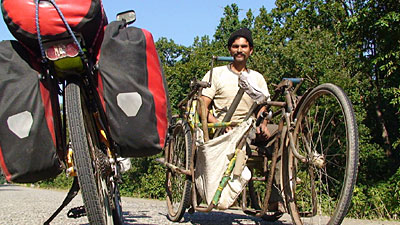
Unfortunately, Christian got sick in Turkey and Uwe did not want to ride through Iran all by himself. Still, Uwe decided to fly to Delhi instead and explored some places in Nepal and India by bike. Sounds like some adventure, doesn't it? If you're interested to read more about their journey, then visit their blog on derStandard.at (sorry, only in German): "Mit dem Rad nach Indien".

Another cyclist on the Mahendranagar HighwayStreet in Bihar

Still, I won't go to India by bike. Nor anywhere else in the near future. My bike is mostly my local transport, but not my roving vehicle :). Got any (bicycle) traveling plans yourself?

Friday, September 18, 2009

First (and second) time cycling in Budapest

As I already mentioned last week, I'm currently attending a Mobility Week Workshop in Budapest, Hungary. It's a meeting of 30 young Europeans from basically 6 different countries (Austria, Czech Republic, Finland, Italy, Hungary, Spain). After exploring the city center and area around the youth hostel Casa de la Musica, we will set different goals and work on how this area could be improved mobility-wise.

My bike impatiently waits for our departure at Wien Südbahnhof

I. (another girl from Vienna) and myself brought our own bikes along. Unfortunately, this is unnecessarily complicated since bike transport is only possible on the slow regional trains. Apart from the longer traveling time (4 rather than 3 hours) this also includes also other disadvantages for cyclists. For example, we had to change trains twice and always drag all our luggage and the bikes up and down the stairs at the stations (no elevators, not even rails on the stairs for wheelchairs – how do disabled people manage that?). Apart from that we didn't arrive at the main station Keleti in Pest but further outside at the Deli station in Buda.

I. at Györ station: changing trains means draging bikes and luggage up and down the stairs

Such things really annoy me. I don't understand why they discourage people to bring along bikes on long distance journeys. I think the EU should really try to work towards a excellent train network that includes possibilities for bike transport. Nowadays it's almost impossible to bring bikes (except folding bikes) on long-distant trains and the situation actually gets worse and worse, at least in and around Austria after the Austrian railway network ÖBB introduced their new Railjet trains that simply don't transport bikes. Such things just make me sad.

So, after all, how is cycling in Budapest? Before we left, we heard all kinds of stories basically saying that cycling in Budapest is very dangerous and that car drivers are aggressive. I must say that I didn't have that impression at all. Of course, there is a lot of car traffic. The roads and lanes are wide and the motorists get priority over everybody else. But cycling in traffic is not so bad. Car drivers leave a lot of space to the side when overtaking and nobody ever honked at us. With all our luggage (both of us had a 50l backpack and a small one) we found our way to the hostel easily and safely. We only had a problem once after we got on a bike path as this one actually lead us away from the Erzsébet bridge rather than onto it. So we ended up carrying our bikes up and down stairs (again) and crossed the Danube on the sidewalk of the bridge. Well, the view was great and we took some nice pictures :-). Though our first cycling trip in Budapest was actually quite pleasant.

Night view from Erzsébet bridge to Buda, Danube and Pest

The next day we cycled through Budapest on rented bikes from Budapestbike in the whole group of 30 people. That way we could see some of the bicycle infrastructure in the city. There is not much and of course there are many improvements that could be made. Compared to Vienna, however, I quite enjoyed that the bike lanes on the road are so wide here and even have an empty space between the parked cars (absolutely necessary and should be standard anyhow, but Viennese planners apparently don't believe in "dooring"). I didn't like the segregated two-way bike paths so much as they are quite narrow and not so visible from the car lanes (always problems with cars turning right that only see cyclists at the last moment). Still, I liked their clear and straight design and that they had a center line. At some places the surface was quite rough though. Very often the bike lanes are painted red at junctions, but the color already faded away.

Cycling in Budapest: cycling in traffic, on a bike lane and a two-way bike path

What I really miss here are one way streets with contraflow cycling traffic. That is something that works very well in Vienna and that really safes me a lot of time in everyday life. They do try to implement such things here too. As mentioned in one of the talks, they also have one advanced stop lane for cyclists (meaning that cyclists can stop in front of the first row of cars at traffic lights, also referred to as 'bike box') and so-called suggested cycle lanes (simply bike pictograms on the road with no real bike infrastructure – I reckon that they are much more efficient than small signs beside the road saying that this is a bike route, as these are not really seen by car drivers).

Concerning bike infrastructure (and generally traffic and spatial planning), Budapest still has a long way to go, but cycling is possible and safe if one is cautious. Cycling, however, is certainly not pleasant here. Still, cyclists in Budapest already represent 3-5% of the modal split which is quite similar to Vienna (as far as I know we have 5% cyclists, but already 8% in the “summer months”), and the numbers are continuously increasing.

More about other aspects of traffic in Budapest and a flashmob by “radical pedestrians” at the Blaha Lujza square in the next post. Stay tuned.

Information of the whole idea and activities in the Mobility Week Workshop on the official website: mobilityweekbudapest.eu. Have a look at the project diary.

Wednesday, September 9, 2009

What's up in Hungary?

Although Hungary is Austria's neighboring country and partner in crime in historical terms (I'm sure you heard about the k.u.k. monarchy), I must admit that I have not been there very often. I remember a rather long visit to Budapest in the early 90s, but apart from that I have only passed trough it a couple of times on my way to the Balkans.

But finally I will pay Hungary a proper visit again. It's all due to the Mobility Week launched in Budapest from 16th to 23rd of September 2009, organized by the Hungarian Cyclists' Club. There will be an international workshop on urban mobility and cityscapes. If you're interested, read more about it on their homepage or at the IG Fahrrad homepage (in German). The project description says:
"The objective of the project is to go over the common and alternative forms of city-scale public and individual means of transport and urban land use along with their ability to remodel the cityscape in negative as well as positive ways. We would like to show directly and clearly, that the direction of these future changes strongly depends on our present attitudes."
Although it was a bit unclear in the beginning, I hope now that I can attend all week, meet nice people and have interesting discussions. Greg Spencer from the Cycling Solution Blog already told me that he will be there and give a talk on the 16th. And seemingly Mikael Colville-Andersen from Copenhagenize.com und Copenhagen Cycle Chic should be there too.

Apart from that, Greg also informed me about the problems they have with the City Hall concerning the Margit bridge renovation in Budapest. Apparently, the orginal costs of 47 Mio. € increased to 77 Mio. €, why they now want to delete a bike path from the project. However, the EU subsides the project with 22 Mio. € including the bike path and there will hopefully be some protests coming from that side now. For more details see Greg's post.

Tuesday, August 18, 2009

An incomplete field study in East Tyrol

I have some relatives in East Tyrol (Osttirol, in German) that I visited for a few days. East Tyrol in the very south of Austria, bordering Italy. To the capital Lienz one can get in a reasonable time from Vienna, but in the rest of East Tyrol it's basically impossible to move around without a car. Well, there is a regional train operating between Lienz and San Candido (in Italy, called Innichen in German), but it's very slow and only connects a few towns. Due to bicycle tourism it runs more often in the summer and it's also fairly easy to bring along bikes. On the other hand, there are no more buses (except school buses), not even taxis, in most of the rural areas although the population is constantly growing.

Due to wide spread settlement it is difficult to operate a good public transport system

My grandma is lucky because she can still walk to the town center on her own and has my cousin looking after her, but for most of the old and young people in East Tyrol living there means heavily depending on people that are entitled and capable to drive a car. Must be very depressing to feel so locked in. My grandma only realized that when my granddad died, who used to drive her around.

Most families own more than one car. The scenery is nice, but they pay a high price for living in houses far away from centers. Strange enough there are also many who choose to live so car-dependent: many build their houses further and further away from basic infrastructure (such that they can't even get a liter of milk without getting in the car) and accept long commutes to work. Bicycles are rarely used on a day-to-day basis.

Cyclist waiting to cross the main road through East Tyrol. Did he go shopping at the petrol station?

However, in the summer one can see many tourists cycling in East Tyrol. Most of them cycle downstream along the Drava cycle path and look like that they only touch a bicycle for one or two weeks in the summer. I'm not really into that type of cycling and I also don't want to promote it (as this is done extensively already), but as part of a field study this is certainly worth mentioning.

Yesterday I read in a newspaper that the city of Lienz supports the purchase of E-bikes by paying 10% (max. 150 €, altogether spends 10.000 €). This is of course a nice gesture and brings bicycles as daily means of transport back into peoples' minds, but similarly to the scraping bonus in Vienna it won't be enough. What cyclists really need is a reasonable infrastructure (e.g. safe bicycle parking in front of shops, restaurants, schools etc.) and bicycle friendly traffic planning and politics. I wasn't particularly looking for it, but I couldn't see any bike path or bike lane in Lienz. And I also couldn't see many cyclists, except road cyclists and tourists. They still have a long way to go, but I wish them good luck in increasing the number of everyday cyclists.

Wednesday, July 1, 2009

Green Bikes visit Linz

On Sunday at 7 am the Green Bikes Tour arrived at Linz to stay here for a couple of days (I already wrote about the project earlier). Yesterday at noon the tour went on to Vienna where they'll arrive on Saturday. Most of the 25 participants came by bus across the alps, other ones joined the tour in Linz and came from Szopron, Hungary, by bike. After ten days of riding in the rain in Italy and Slovenia, it was rainy in Linz, too. Sorry folks!

My cycling organization helped the tour here in Upper Austria with accommodation, meals, workshop, and all kinds of other stuff. Since I did most of the work I had some busy days (on Saturday, with Anna's help I managed to buy lots of food for nearly 30 people without a car), but I met really nice people, learned some interesting things at the workshops (especially one in a village near Linz on spatial planning, revitalization of rural areas, and re-naturalization of the landscape) and had a lot of fun!

I didn't take any photos by myself, so I may refer to the official GBfP - website. It will be updated soon! And I'm sure Adam, Tomas, and all the other cyclists will be happy about comments!

Thursday, June 4, 2009

A cyclist's trunk

Frequently people address my backpack. This appears somehow funny to me, like telling a motorist that he has got an awesome trunk.

A couple of years ago I got myself an Ortlieb Messenger Bag and this is what it says in black letters on orange tarpaulin. Hence many cyclists mistake me for a bicycle courier.

The really loud color makes be being seen and tarpaulin -- in combination with the ingenious roll closure -- makes it water proof (tested under the shower) and easy to clean. With a capacity of 30 liters it is large enough for weekend trips and most shopping tours. Still comfortable to wear when it is fully packed it meets my needs almost perfectly. The only thing I miss is a hand strap. I think that some of the newer models feature one.

What else could one ask for? Anna criticizes the lack of different compartments. I don't miss them, but Ortlieb offers inner pockets, dividers and other optional accessories.

Thursday, April 23, 2009

My first bike video

So this is the video I did when cycling in Barcelona (see an earlier post for my overall impression):


About the video
It contains material about cycling along the harbor and seafront. The second bit follows a few women cycling along the Diagonal (one of the main roads in Barcelona).

Techniques
I was cycling with the BiCiNg bikes all the time and therefore used my small and robust (but poor in filming) Olympus photo camera. My gorillapod (the small version) was handy for the quick mount and release I needed, but on the other hand this tripod shakes quite a lot too because of the flexible joints. As a Linux user I used kdenlive to cut the videos. This program is much more powerful, but I'm just a beginner so for this time I took it easy. I changed the video to black&white due to the horrible color abberation and blurring of my camera.

Feel free to criticize, I'm grateful for any advice. I know that the quality isn't great and that I probably would have needed more material in order to create a more lively video. But well, it's just my first try.

By the way, does anybody of you know a proper tripod that can easily be mounted to handlebars and that can safely hold DV camcorders (mine weighs around 600g) or SLR cameras?

Thursday, April 16, 2009

Anna cycling in Barcelona

Hola, this is actually anna from Vienna. I'm currently visiting Catalonia. It's a surprise visit for the other Anna, organized by her boyfriend Xavi. He also ensures that I do a lot of bicing and sightseeing while Anna is busy at work :-). I've been to Barcelona before in 2002, but only for one day. I think many things have changed the face of the city ever since, especially the cycling boom that has started with BiCiNg (Anna was damn right about that). So here are just a few of my impressions and comparisons to Vienna:

Bicycles
The vast majority of the cyclists here use BiCiNg bikes, second probably being folding bikes (quite unusual for me). BiCiNg bikes have three gears (the new Citybikes in Vienna will also have that), pneumatic tires (compared to solid rubber tires in Vienna), a refreshing red color and all the good stuff (fenders, chain and skirt guard, front rack, lights). In Vienna borrowing the city bikes is more involved, but you can choose the bike yourself. Here, the system chooses it for you and sometimes you have to repeat the procedure if you catch a broken bike.

Me bicing at the seafront this morning
By the way, can anybody explain me the sense of a smaller front tire?


Saturday, April 4, 2009

Un-cycling in Oviedo

Last weekend I was on a short trip to Oviedo. Rainy Oviedo. For those who still believe Spain is a sunny country, well, it is not. At least up in the north, where the oceanic climate reigns. Never in my life had I experienced such unstable weather!

Thinking about the blog I observed all people in the street. I saw people driving cars, I saw people walking but I saw no one cycling. How can it be?

Oviedo's cathedral

First, we could appeal to the days of the week. It was Saturday and Sunday, and especially on Sunday there was very rarely anyone in the streets. But this is not a very valid reason.

Then we could say Oviedo is a small city (around 225 thousand citizens) and cycling suits best in big cities or leisure trips in the countryside. Well, this is not a valid reason either.

Finally, what is, in my understanding something more logical to set aside cycling as a way of moving across the city is the weather. Well, sure, thousands of people cycle in the snow, in the cold and in the rain, as many bloggers explain, but I think Oviedo's weather is too unstable. You do not know whether is going to rain or not. At least at this time of the year. These couple of days I stayed there I experienced everything from moist, thin rain, showers, hailstones and sun. Besides the cold. All in the same hour. And all the day was like this. I guess that you can cycle when it rains, but when it is pouring or hailing? And what is more: how can you face this constant-ever-changing weather if you ride a bike regularly?


Oviedo: Plaza del Paraguas (Umbrella square)


For certain, Spain is finally (!!!) changing some of its moving habits in cities. Bikes are filling cities like Barcelona and Seville, but I am not sure it will be the case of the north. Mainly because of this kind of too unstable weather. Maybe I am just making excuses for them or maybe I am totally wrong. If someone live in an area such as this I described and cycles, please tell how you get through ;).

Santa María del Naranco, a preromanic church (IX century) in a hill with
views of Oviedo


Anna from BCN

Monday, February 23, 2009

What's different in Innsbruck?

Last week I attended a workshop in Innsbruck, Tyrol. Innsbruck is a real mountain town in the alps. It is named after the river Inn and a bridge (Bruck means Brücke in the Tyrolian dialect and bridge in English). It is situated in a nice valley and surrounded by very high mountains. Innsbruck is 574m above the Adriatic sea and has ~120.000 inhabitants (~200.000 in the agglomeration). Many tourists go there for skiing in the winter.

Coming back to my first question, what's different in Innsbruck? Well, firstly it is much colder than in Vienna. Last week the temperatures went down to -15°C (even below -20°C in some other parts of Tyrol). And whenever it wasn't freezing, it snowed heavily.

Still, there were incredibly many people around cycling. Within 5min I could see more cyclists in Innsbruck than I usually see in Vienna within a whole day (ok, I usually don't spend all day cycling around, but still). Nobody would say that cycling in the winter is impossible or just something for weirdos. Many people cycle in the winter in Innsbruck. They probably wouldn't even think about leaving their bikes at home if the temperatures are far below -10°C and if there are a few decimeters of fresh snow on the roads. The latter actually even was the case when I was there, as I already mentioned.


In my opinion, cycling in Innsbruck isn't more or less dangerous than in Vienna. In fact, there are hardly any bike lanes or paths, and the cars are much faster because the roads are wider and there are no traffic jams that slow car drivers down. But it's just a different mentality. Cycling in Tyrol generally, even in the winter, seems as normal as having a coffee for breakfast. They don't wear helmets nor any particular cycling clothes. They simply cycle because it's practical and fast.


By the way, Tyrol itself has the second highest percentage of cyclists in the modal share in Austria - around 8%. Only further west, in Vorarlberg, it is higher with approx. 15%. That's where I originally come from :-). In comparision, in Vienna there are only 4% cyclists. On average, we have around 7% cyclists in the modal share in Austria, which is quite low compared to other European countries (this numbers were published by the VCÖ in the beginning of 2008). To me it's really strange that the parts with the highest percentage of cyclists in Austria are the west and most alpine ones, where it is much colder and where there is much more precipitation (both rain and snow). Plus, there are also more hills and mountains. It's similar in Switzerland, where there are even more cyclists although it is an alpine region. Hopefully one day this miracle will reveal itself to me.

As you can see I took many pictures of cyclists in Innsbruck – enjoy!

Sunday, February 8, 2009

Day trip to Bratislava

Yesterday Anna and I were in Bratislava. We got there by train from Vienna South Station within 1 hour travelling time to Bratislava – Petrizalka. There is an EURegio – Ticket including roundtrip, public transport in Bratislava (which is very nice, because the Petrizalka station is far off the center), and also bicycle transportation. The ticket costs 14 EUR, which is quite cheap. On the other hand, one could go there by bike. Bratislava is only 60 km away from Vienna which is a nice distance for a recreational ride along the Danube/EuroVelo Route 6.

First thing I noticed in Bratislava was the absence of bicycles. There are no parked cycles, hardly any bike racks, and only a small number of riders although the weather was very nice and warm. Bike lanes seem to be available only in places where it would be impossible to ride otherwise, like the bridges over the Danube. For the most part the old town is a pedestrian area. I don't know if riding a bike is allowed there, but since the streets are paved with cobblestone, it wouldn't be very comfortable.

In the afternoon we watched some trial bikers fooling around at a wall. Anna took some pictures.